Real client · In production
Bungalows Aguazul
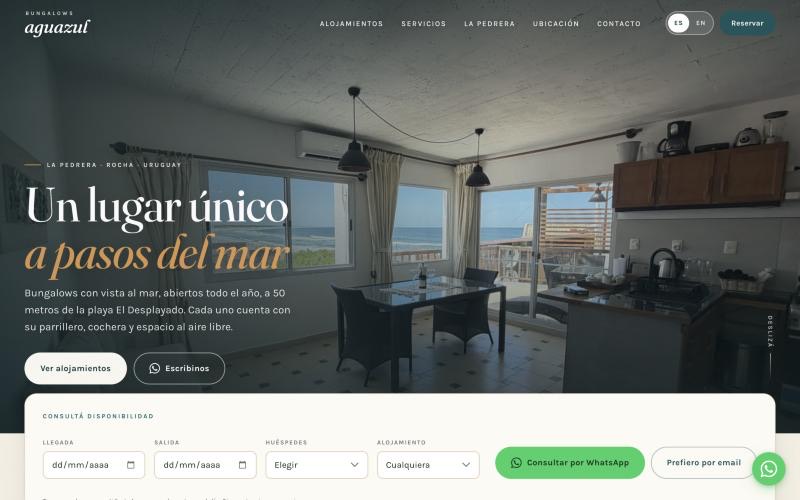
Site for a seafront bungalow complex in La Pedrera, open 365 days a year.
- Role
- Design and development
- Year
- 2026
- Stack
- HTMLCSSJavaScriptES/EN i18nCloudflare
The problem
Aguazul has been hosting guests in La Pedrera since 2002, but had no site showing its six units or explaining what each one includes. Enquiries arrived by WhatsApp and phone, and the same questions — how many people fit, is there a grill, how far is the beach — came up in every conversation. The site had to answer all of that before anyone writes, and still push the enquiry to the channel the complex already uses.
What I built
- A page for each of the six units, from the studio for two to the two-bedroom bungalow with a sea view, with capacity and amenities.
- An availability enquiry with dates, guest count and unit type that composes the message and sends it over WhatsApp or email.
- An amenities section: grill, covered parking, linen, housekeeping, air conditioning, night security.
- A guide to the resort town and nearby trips (Cabo Polonio, Laguna de Rocha, Santa Teresa) with distances.
- A photo gallery of the complex, the units and the beach.
- A full English version for the tourism arriving from abroad.
Technical decisions
Spanish lives in the HTML; JavaScript adds the English
Translations are applied through data-i18n attributes on the markup. If the JavaScript fails to load, the site is still a complete Spanish site rather than an empty page — and Google indexes the content without having to run scripts.
An availability enquiry, not a booking engine
The complex confirms availability by hand and takes payment its own way. A real booking engine would have been a separate system, with payments and a double-booking risk. The form composes the enquiry with dates, guests and unit, and drops it into WhatsApp, where the complex already answers.
Selling the town, not just the bungalow
Plenty of people search for "what to do in La Pedrera" before looking for a specific place to stay. The sections about the town and the nearby trips exist to answer that search and bring those people to the site, not as decoration.
Plain HTML, CSS and JavaScript
It is a content site with a form. With no build step and no dependencies it loads fast on a phone with the signal you actually get on the coast, and the owners can ask for a copy or price change without anything being recompiled.
What I took away
- Building my own translation layer with data-* attributes, and keeping the site working when the JavaScript doesn't.
- Structuring a long, multi-section site so it can be navigated on a phone without getting lost.
- That the form has to end where the client already answers: fighting that habit only loses enquiries.